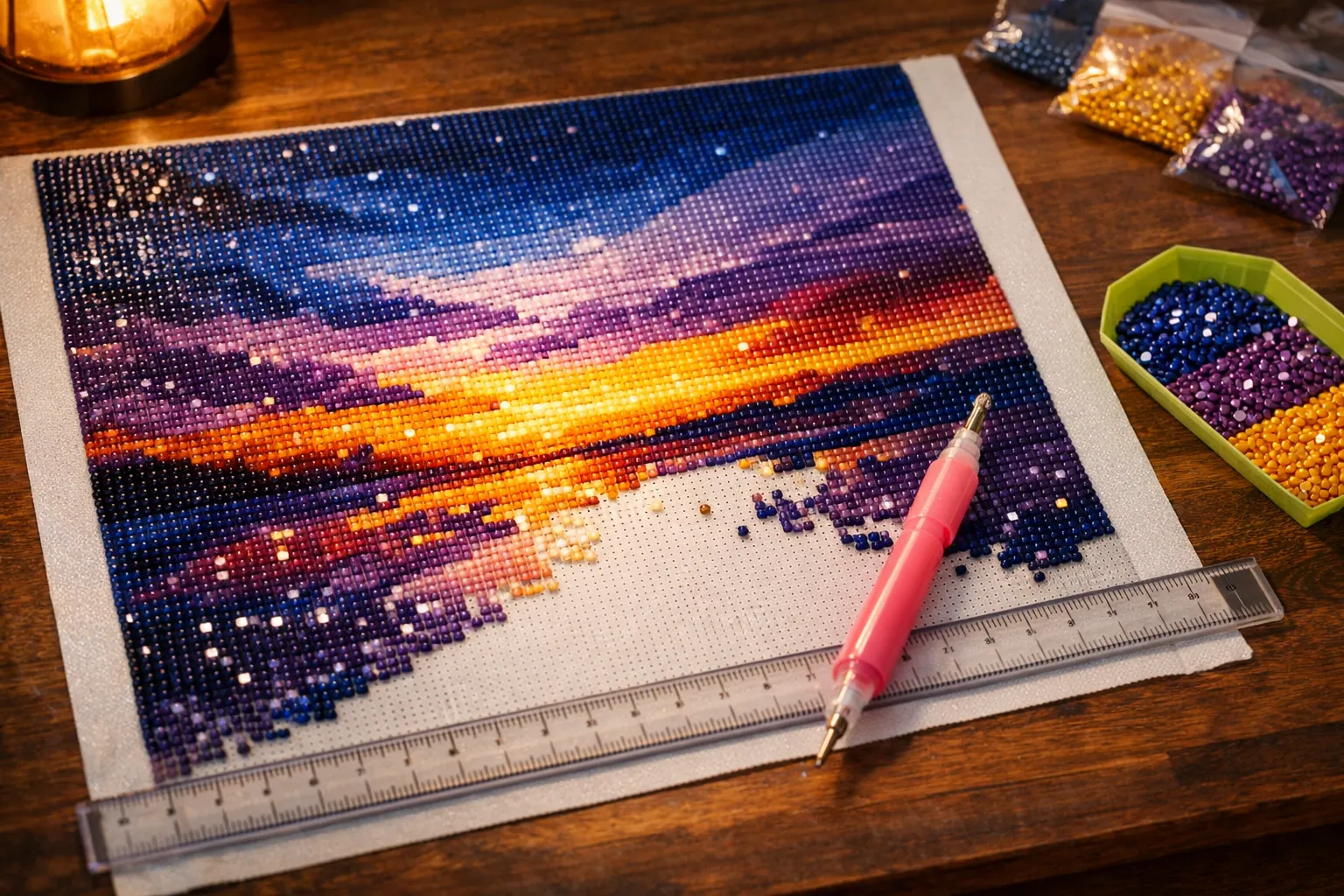
Enter the canvas size from the kit listing and this calculator gives you the drill count, the hours it will take at your own pace, and whether a kit started now can be finished by Christmas or any other date. How long a diamond painting takes is its drill count divided by your pace. The most common Amazon kit, 12x16 inches with round drills, holds about 13,464 drills, which is about 38 hours at 350 drills an hour. The hours table below covers every common size. If this is your first kit, our how to do diamond painting walkthrough breaks the time down step by step. The calculator handles the unpainted border most kits have, partial-drill designs and round, square or custom drill sizes, then suggests a light pad and frame that fit. Turn drill counts into inches, then pick a frame from diamond painting frame sizes.
Common kit sizes (fills width and height):
Assumptions: square drills sit on a 2.5 mm grid and round drills on a 2.8 mm grid (the sizes Diamond Art Club gives; Diamond Dotz round drills are 2.88 mm, so use the custom size for those). A half-inch border is our default guess for a listed canvas size, so measure yours. Paces are presets, not measurements: time yourself for the real number. Partial drills can't be placed, so the grid always rounds down.
Once you know the finished size, the best diamond painting frames guide shows which frames fit common kit sizes.
How the calculator works
A diamond painting is a grid. Each drill sits in one cell, so the count is just how many cells fit across times how many fit down. Three numbers decide it: the painted size, the drill size and how much of the design is covered.
- Find the painted area. Most listings give the canvas size, and the canvas has a plain border you never cover, so the calculator subtracts the border from each side. Choose "painted design area" if you measured the design itself.
- Count the cells across: width in millimeters ÷ drill size, rounded down. Height works the same way. A part-cell can't hold a drill, so it never rounds up.
- Multiply columns by rows for the drill count, then by the coverage for a partial-drill kit.
- Divide drills by drills per hour for the hours. Days are hours ÷ hours a day, rounded up to whole days.
- For a deadline, divide the hours by the days between your start date and the finish-by date. That's the hours a day you need.
The drill sizes come from the makers. Diamond Art Club's guide to round and square drills gives 2.5 mm for square and 2.8 mm for round. Diamond Dotz's drill guide lists its own round drills at 2.88 mm, plus 2 mm minis and 5 mm drills in its kids' kits. That spread is why there's a custom size: if your kit's chart says something different, use the kit's number. Light pad sizes are the ISO 216 paper sizes (A4 is 210 × 297 mm, A3 is 297 × 420 mm, A2 is 420 × 594 mm).
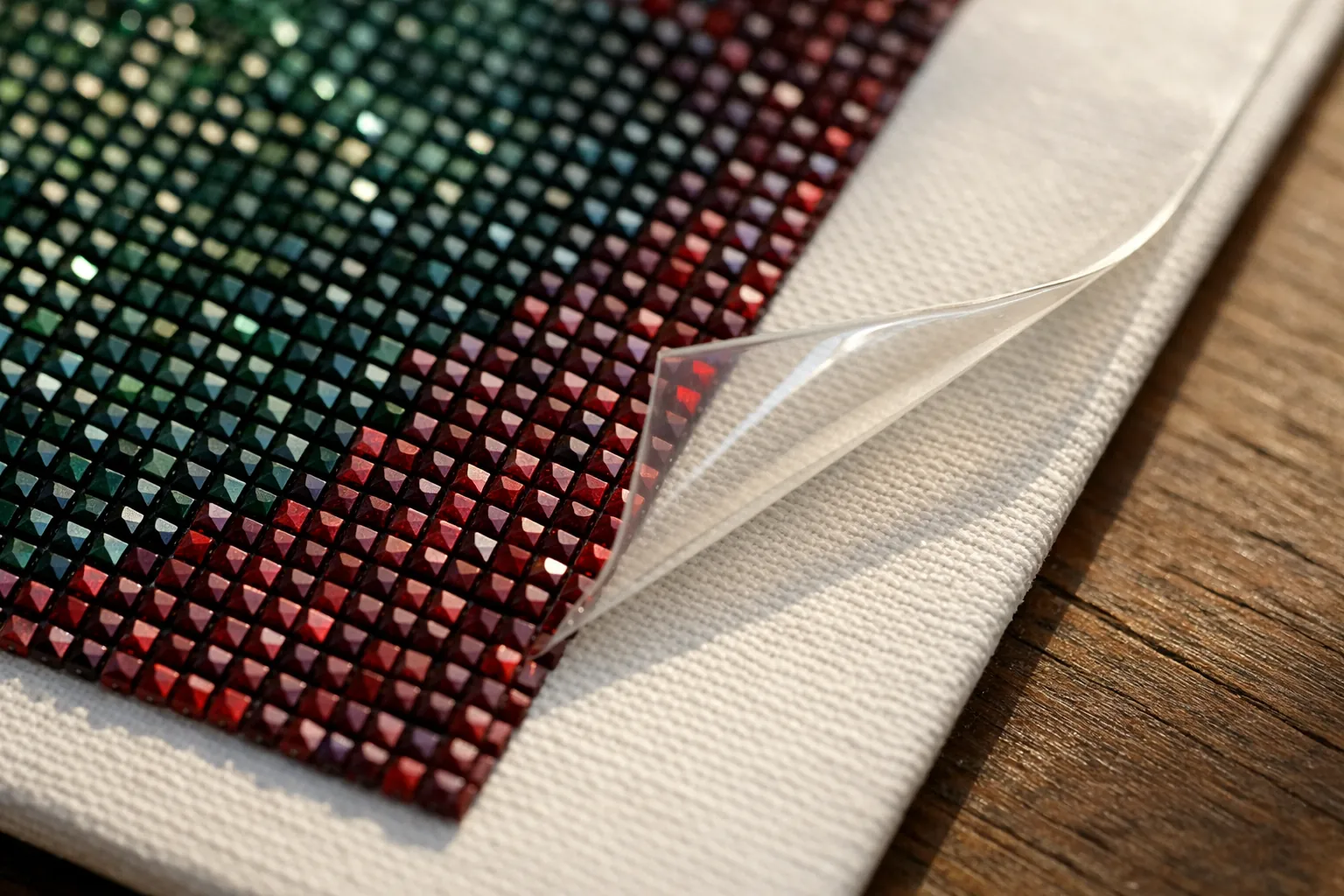
The pace number is the one to check
No one publishes a measured average for drills per hour, so treat our presets as starting guesses (250 an hour for a first kit up to 600 with a multi-placer). Your real pace depends on the drill shape, how many colors change in a small area and whether you use a multi-placer on big single-color patches. Square drills also take a little more care to line up.
Time yourself instead. Set a timer for 10 minutes, and place drills at your normal pace. Count them, then multiply by 6. Do it on a busy part of the design and again on a plain sky, then use the average. Pick "My own timed pace" in the calculator and type it in.
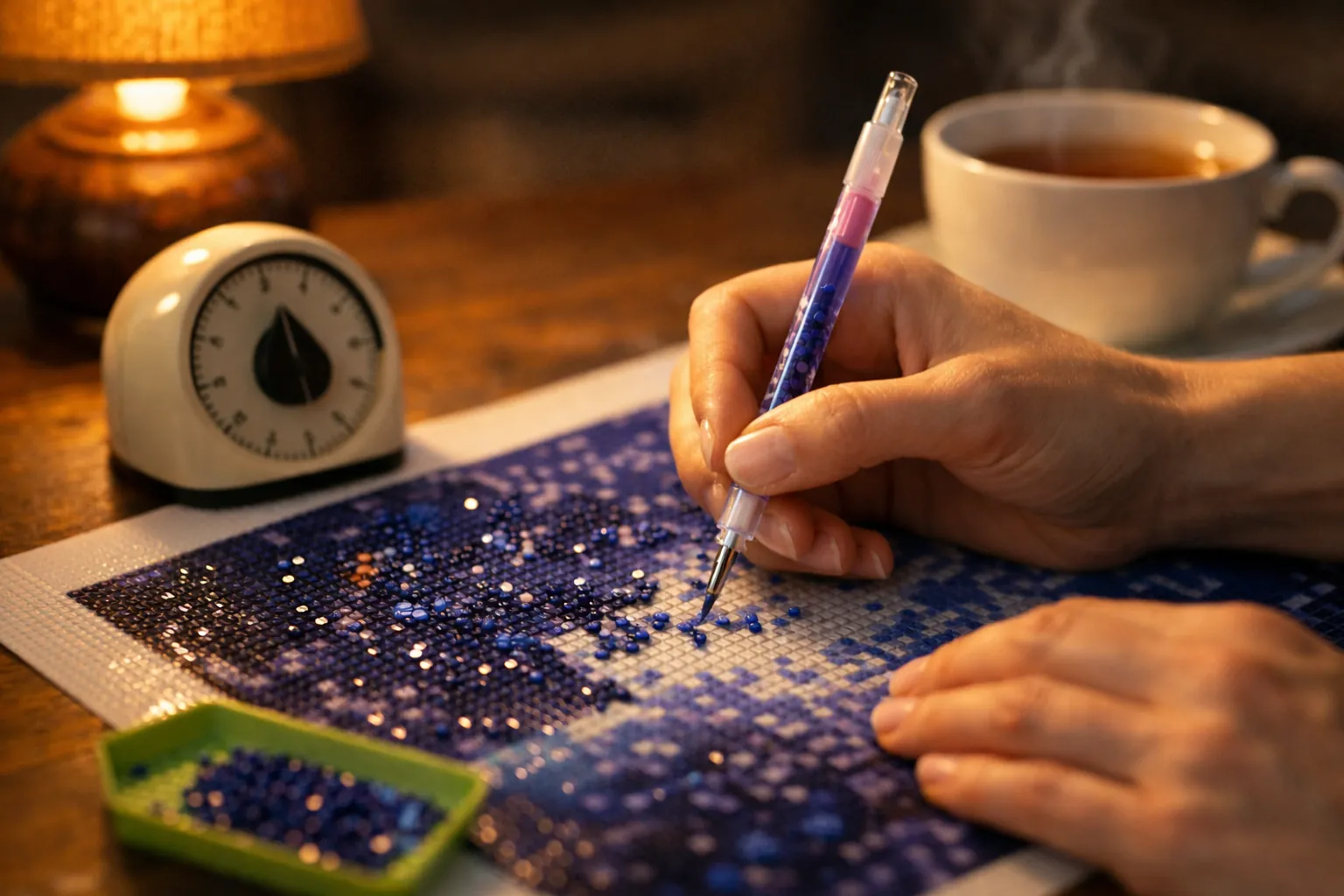
Hours by canvas size, at three paces
Every number here comes from the same formula as the calculator above: subtract a half-inch unpainted border from each side, count how many drills fit across and down (square drills at 2.5 mm, round at 2.8 mm), then divide by drills per hour. The three paces are assumptions, not measurements.
| Canvas | Drill | Drills | 250/hour | 350/hour | 600/hour | Days at 1.5 h/day (350/h) |
|---|---|---|---|---|---|---|
| 8 × 8 in | Round | 3,969 | 16 h | 11 h | 7 h | 8 |
| 8 × 8 in | Square | 5,041 | 20 h | 14 h | 8 h | 10 |
| 12 × 12 in | Round | 9,801 | 39 h | 28 h | 16 h | 19 |
| 12 × 12 in | Square | 12,321 | 49 h | 35 h | 21 h | 24 |
| 30 × 40 cm | Round | 13,034 | 52 h | 37 h | 22 h | 25 |
| 12 × 16 in | Round | 13,464 | 54 h | 38 h | 22 h | 26 |
| 30 × 40 cm | Square | 16,241 | 65 h | 46 h | 27 h | 31 |
| 12 × 16 in | Square | 16,872 | 67 h | 48 h | 28 h | 33 |
| 40 × 50 cm | Round | 22,477 | 90 h | 64 h | 37 h | 43 |
| 16 × 20 in | Round | 23,392 | 94 h | 67 h | 39 h | 45 |
| 40 × 50 cm | Square | 28,161 | 113 h | 80 h | 47 h | 54 |
| 16 × 20 in | Square | 29,336 | 117 h | 84 h | 49 h | 56 |
| 20 × 24 in | Round | 35,776 | 143 h | 102 h | 60 h | 69 |
| 50 × 70 cm | Round | 40,560 | 162 h | 116 h | 68 h | 78 |
| 20 × 24 in | Square | 44,969 | 180 h | 128 h | 75 h | 86 |
| 50 × 70 cm | Square | 50,841 | 203 h | 145 h | 85 h | 97 |
| 60 × 80 cm | Round | 56,580 | 226 h | 162 h | 94 h | 108 |
| 60 × 80 cm | Square | 70,761 | 283 h | 202 h | 118 h | 135 |
Drill counts assume a full-drill design with a ½ in border on each side of the listed size. Partial-drill kits take proportionally less: a design that's 60% covered takes about 60% of the time. Measure your own border, since some kits leave more than an inch.
Why the hour figures you see online don't add up
Search this question and you'll find hour ranges with no drill count and no pace behind them. Any hours figure is drills ÷ pace, so a range that doesn't say which canvas and which pace can't be checked. Run the numbers and the gaps show up fast: 30,000 drills at a brisk 400 an hour is still 75 hours.
The other thing estimates miss is that pace isn't fixed. A plain sky goes fast, especially with a multi-placer. A face or a busy floral with a color change every few drills goes slowly, because most of the time is spent switching trays and finding symbols. Two kits with the same drill count can differ by a lot.
What actually makes you faster
Most time goes on picking up drills one at a time and on changing colors. Fix those two and the hours drop.
Multi-placer tips for big color areas
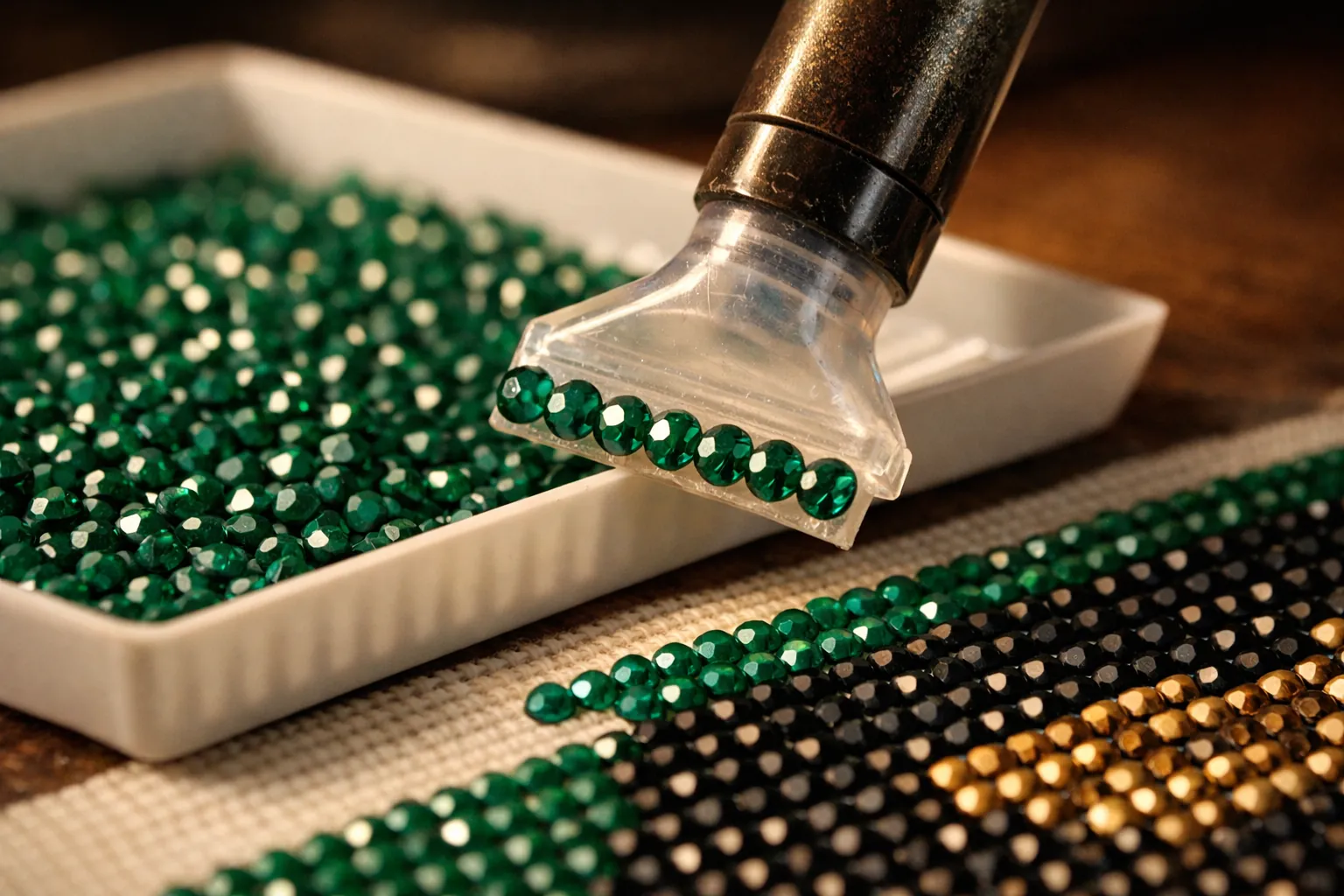
A multi-placer picks up a short row of drills at once. On a background of one color it's the biggest single speed-up there is. The RovyFota resin pen comes with 3-, 6- and 9-drill placer tips, and the seller claims up to twice the speed of a regular stylus (that's their figure, not ours). It has nearly 2,000 Amazon ratings at 4.7 stars. Multi-placers help much less in detailed areas, where you're placing single drills of many colors. Our diamond painting pen guide compares more options.
Trays you don't have to empty
Pouring drills back into bags between colors wastes minutes every session. A set of trays lets you keep several colors open. The ARTDOT 10-piece tray set clips trays together side by side and stacks them when you stop, with a raised lip to stop spills when you shake the drills flat. See our tray picks for lidded versions.
Light and drill shape
Dark canvases with small symbols slow everyone down. A light pad under the canvas makes symbols easier to read, and the Ratukall A4 light pad kit has three brightness levels and comes with a stand plus storage boxes. Drill shape matters too. Round drills are bigger, so a 12x16 inch round kit has about a fifth fewer drills than the square version, and they don't need lining up edge to edge. Square vs round covers the trade-off in finish.
Planning around a gift date
Work backward from the date. From early October to December 25 is about 80 days. At an hour and a half a day and 350 drills an hour, that's room for about 42,000 drills, which covers a 16x20 inch square-drill kit or a 20x24 round with time to spare. Leave the last few days for sealing and framing, and check the delivery estimate on the listing before you count on a start date. Our Christmas diamond art kits page sorts holiday kits by how long they take. The "finish by" box above does this sum for any date and tells you how many minutes a day you need.
If the number comes back too big, buy a smaller canvas. Cutting the size is a much bigger saving than any tool: a 12x12 inch round kit is about a quarter of the drills of a 20x24. Shorter still, our mini diamond painting kits page lists 5x7 to 8x8 sets that take a few evenings, not weeks.
Diamond painting size chart: drills by canvas size
This chart answers the "how many drills in a 30x40" question for the common sizes. The first two columns assume the whole size is painted. The last two take off a half-inch border on each side, which is closer to what a typical kit listing means by its canvas size.
| Size | Square, full size | Round, full size | Square, ½ in border | Round, ½ in border |
|---|---|---|---|---|
| 20 × 20 cm | 6,400 | 5,041 | 4,761 | 3,844 |
| 8 × 8 in | 6,561 | 5,184 | 5,041 | 3,969 |
| 30 × 30 cm | 14,400 | 11,449 | 11,881 | 9,604 |
| 12 × 12 in | 14,641 | 11,664 | 12,321 | 9,801 |
| 30 × 40 cm | 19,200 | 15,194 | 16,241 | 13,034 |
| 12 × 16 in | 19,602 | 15,660 | 16,872 | 13,464 |
| 40 × 50 cm | 32,000 | 25,276 | 28,161 | 22,477 |
| 16 × 20 in | 32,886 | 26,245 | 29,336 | 23,392 |
| 40 × 60 cm | 38,400 | 30,388 | 34,121 | 27,265 |
| 40 × 70 cm | 44,800 | 35,500 | 40,081 | 31,920 |
| 20 × 24 in | 49,329 | 39,277 | 44,969 | 35,776 |
| 50 × 70 cm | 56,000 | 44,500 | 50,841 | 40,560 |
| 60 × 80 cm | 76,800 | 60,990 | 70,761 | 56,580 |
| 24 × 32 in | 78,975 | 62,930 | 73,162 | 58,448 |
Square at 2.5 mm, round at 2.8 mm. Real kits vary by a few percent with the maker's grid and border. For hours, divide by your drills per hour: a 12 × 16 in round kit at 350 an hour is about 38.5 hours, and the hours table above has the full set of sizes and paces.
Check the math
We tested the formula against hand-worked examples and one published kit. Open each one to see the steps; the calculator gives the same answers with the same inputs.
30 × 40 cm, design area, square drills: 19,200 drills
300 mm ÷ 2.5 = 120 columns. 400 mm ÷ 2.5 = 160 rows. 120 × 160 = 19,200 drills. At 350 drills an hour that's 54.9 hours, and at 1.5 hours a day, 37 days. With round drills: 300 ÷ 2.8 = 107.1, so 107 columns; 400 ÷ 2.8 = 142.9, so 142 rows; 107 × 142 = 15,194.
12 × 16 in whole canvas, ½ in border, round drills: 13,464 drills, 38.5 hours, 0.54 h a day to make Christmas
Take half an inch off each side: 11 × 15 in painted, which is 279.4 × 381.0 mm. 279.4 ÷ 2.8 = 99.8, so 99 columns. 381.0 ÷ 2.8 = 136.1, so 136 rows. 99 × 136 = 13,464 drills.
At 350 an hour: 13,464 ÷ 350 = 38.5 hours. At 1.5 hours a day: 38.47 ÷ 1.5 = 25.6, rounded up to 26 days.
Deadline: start October 15, 2026, with December 25, 2026 as the finish-by date. That's 17 days left in October, 30 in November and 24 in December before the 25th, or 71 days. 38.47 ÷ 71 = 0.54 hours a day, about 33 minutes. On track.
The same canvas with square drills: 279.4 ÷ 2.5 = 111 columns, 381.0 ÷ 2.5 = 152 rows, 16,872 drills. A 60% partial-drill version of the round kit: 13,464 × 0.6 = 8,078 drills.
40 × 50 cm whole canvas, ½ in border: 28,161 square drills
400 − 25.4 = 374.6 mm and 500 − 25.4 = 474.6 mm. Square: 149 × 189 = 28,161. Round: 133 × 169 = 22,477. The painted area is larger than A3 (297 × 420 mm) and fits A2 (420 × 594 mm), so the calculator suggests an A2 pad or sliding an A3.
Checked against a real kit: 115,360 calculated vs 116,053 listed
Diamond Art Club lists its Lighthouse in the Night kit at 40.6 × 27.6 in with 116,053 square drills (checked October 3, 2026). As a design area with square drills: 40.6 in = 1031.2 mm, ÷ 2.5 = 412 columns. 27.6 in = 701.0 mm, ÷ 2.5 = 280 rows. 412 × 280 = 115,360, which is 693 drills or 0.6% under the listed count. Close enough to trust the formula for planning, and a reminder that a maker's own grid can differ slightly.
What the calculator can't know
It works from a size and a drill pitch, so a few things throw it off. Some round-drill kits print on a 2.5 mm grid with drills that nearly touch, which gives more drills than the 2.8 mm assumption. Borders vary from a narrow strip to more than an inch. Special-shape and AB drills don't change the count, but a crowded design with many color changes slows you down, so the hours are always the soft number. Kit drill bags also include spares, so don't expect the bag count to match the canvas count.
It also doesn't do prices or shipping. Working to a gift date? Check the delivery estimate on the listing before you count on the finish date here.
Using the results
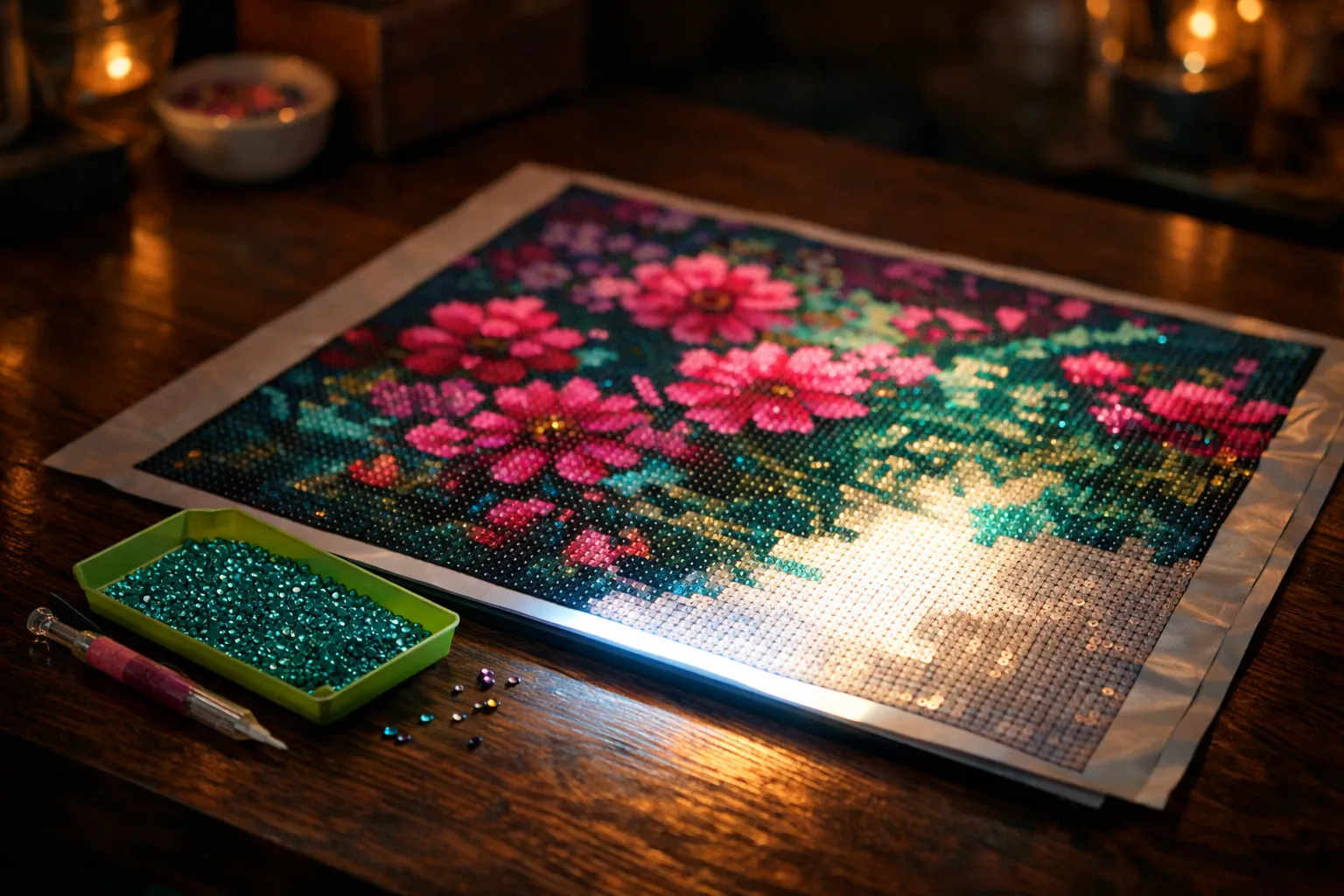
The light pad line compares the painted area with A-series sizes; our light pad guide lists real lit areas by model. The frame line adds a quarter-inch reveal and finds the next standard US frame, and how to frame diamond art covers mats and depth. For a big canvas, our large full-drill kit picks list the sizes, and if you're torn between drill shapes, square vs round explains the trade-off. Write your total drills and hours on the free project log so you can see your real pace next time. Planning your own design? The pattern maker guide turns a canvas size into a grid.
If the deadline check comes back tight, the quickest gain is usually a multi-placer pen for large single-color areas, followed by sorted drill storage so you aren't hunting for codes.
Tools that match common results
- Design fits A4 (up to about 8 × 11 in painted): the Ratukall A4 light pad kit, which has three brightness levels and comes with a stand.
- Design needs A3 (most 12 × 16 in and 30 × 40 cm kits): the Ratukall A3 light pad.
- Deadline looks tight: a pen with multi-placer tips, like the RovyFota resin pen with 3-, 6- and 9-drill tips.
- Lots of colors to keep apart: the ARTDOT 60-slot storage case, which has more than 31,000 Amazon ratings.
Sources: Diamond Art Club drill guide, round vs square drill sizes and Lighthouse in the Night listing, Diamond Dotz drill guide, ISO 216 paper sizes. Product details from each Amazon listing. All checked October 3, 2026; the links show the current price on Amazon. How we research · Affiliate disclosure