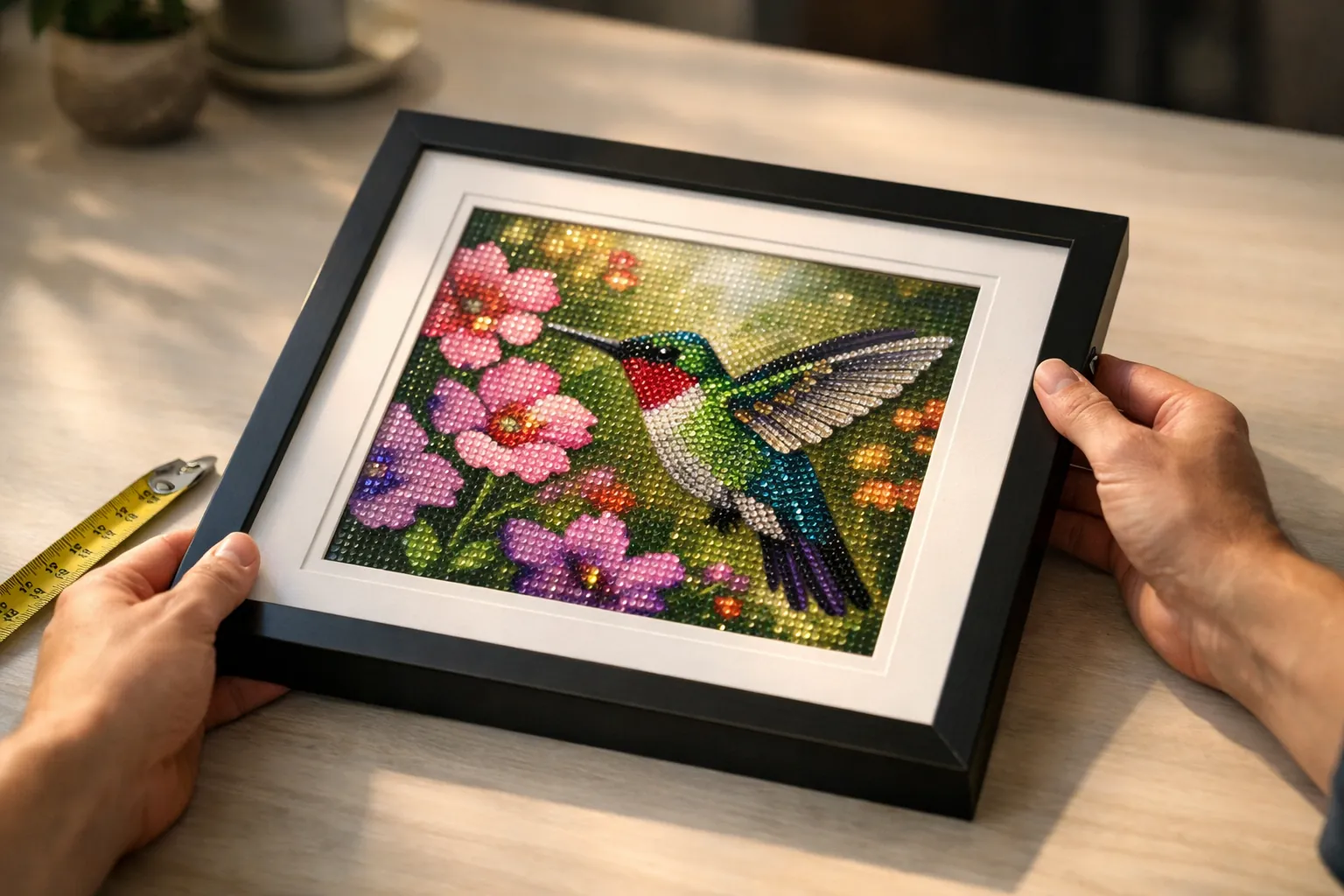
Measure the painted area, not the whole canvas, then buy a frame and mat that hide the unpainted border. If you'd rather skip the frame, wrap the canvas around stretcher bars. Most kits are 30x40 cm (about 12x16 inches), and for those a 12x16 inch frame with a 10x14 inch mat fits without any cutting. The size chart below covers the other common kits.
Prefer not to frame at all? Our guide to hanging diamond art without a frame covers other ways to put a finished canvas on the wall.
How to frame a diamond painting: three ways
There are three common routes, and the right one depends on whether you want the border hidden, visible or gone.
| Method | What you see | Best when | Watch for |
|---|---|---|---|
| Frame with a mat | Painted area only; the mat covers the border | You want the quickest result and no cutting | Mat opening must sit just inside the painted area |
| Floating frame | The whole canvas, with a small gap around it | The border is clean and you like a gallery look | Frame must be bigger than the canvas, and the border shows |
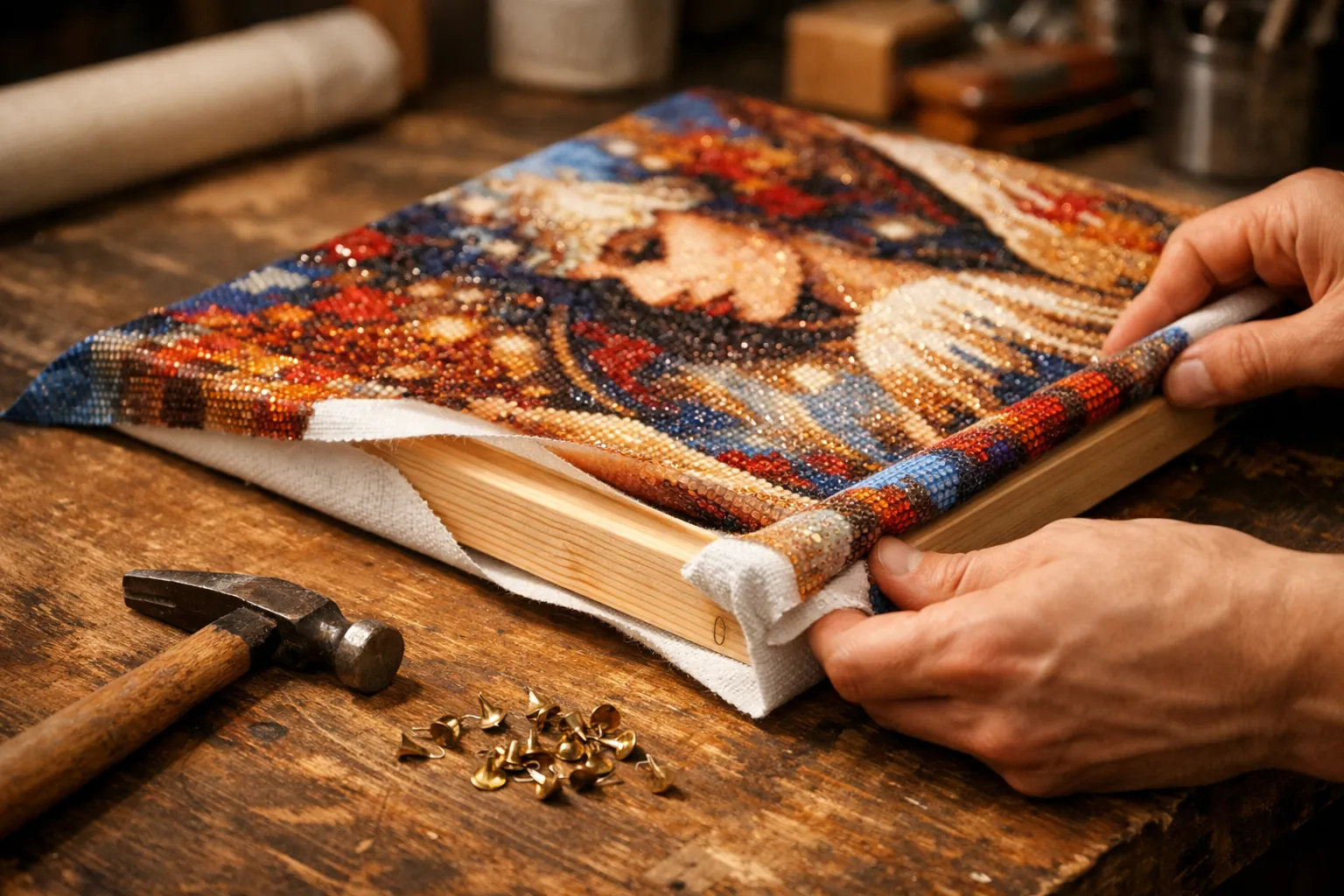
| Stretcher bars | Painted area wrapped around the edges, no frame | You want a canvas look and have a wide border | No cover, so seal first |
The steps for the first and third are below. The floating option has its own section, since it changes which size you buy.
About this guide
The steps reflect standard framing practice for canvas art and the fit notes printed in frame listings. The frames we link were among Amazon's best sellers for diamond art on October 3, 2026. Their sizes are the sellers' own. We don't claim to have framed each one. How we research.
Step 1: measure the painted area
Every kit canvas has a plain border around the design, often with the color legend printed on it. Two measurements matter. The frame has to fit the canvas, and the mat or frame opening has to fit the painted area.
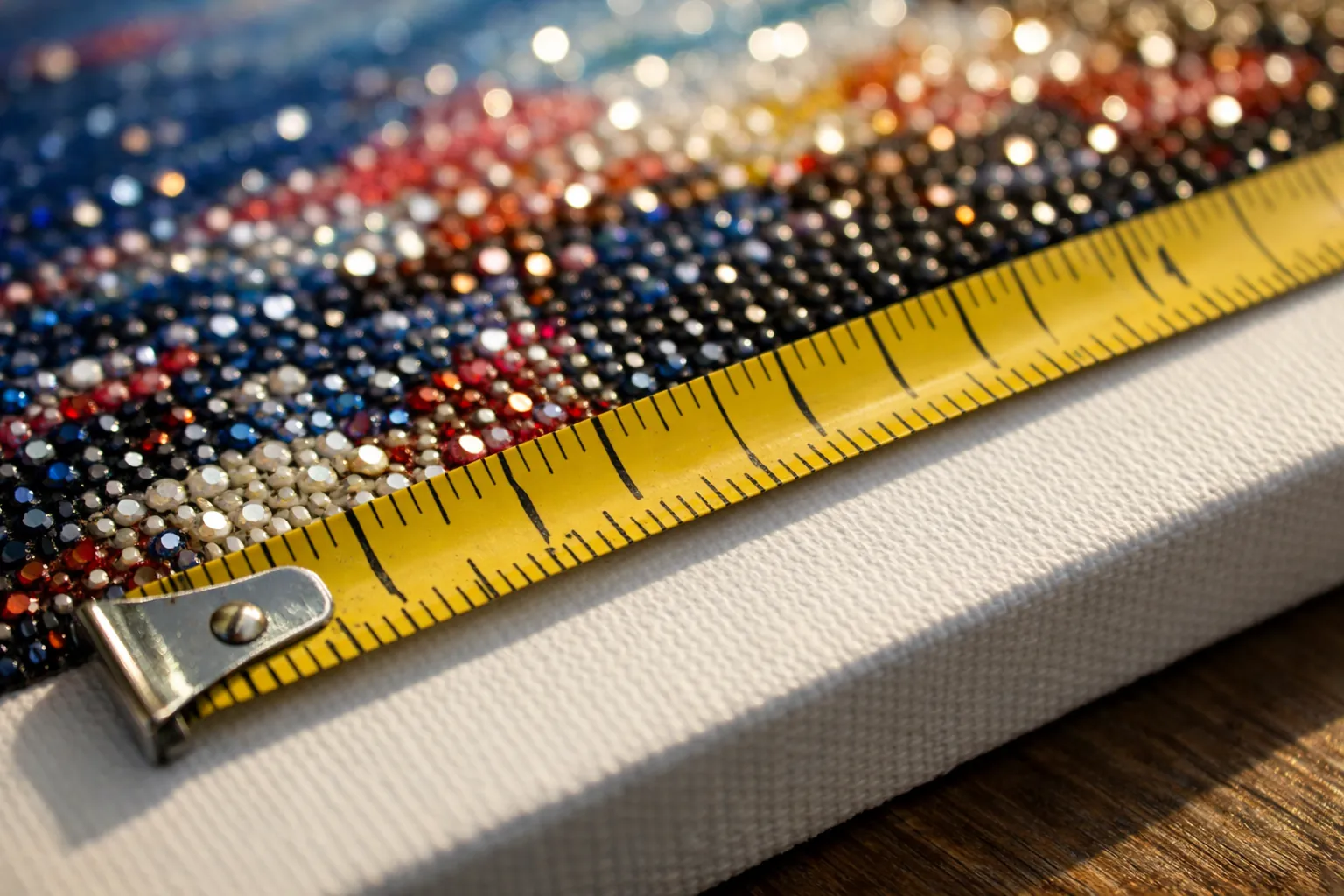
Step 2: pick a frame size
| Kit canvas | No cutting | If you trim the border |
|---|---|---|
| 30 x 30 cm (about 12 x 12 in) | 12x12 in frame with a 10x10 in mat: black or white solid wood | Smaller square frame sized to the painted area |
| 30 x 40 cm (about 12 x 16 in) | 12x16 in frame with 10x14 in mat | 10x14 in frame (check the listing's trim size) |
| 35 x 35 cm (about 14 x 14 in) | 14x14 in wood frame with mat (2 pack) | Smaller square frame sized to the painted area |
| 40 x 70 cm panoramas and larger | Panoramic frame or stretcher bars | Stretcher bars sized to the painted area |
Fit notes come from the frame sellers' listings. Kit borders vary, so measure your own canvas before ordering.
Step 3: frame it in a picture frame
- Roll the painting so every drill is pressed down. A diamond painting roller makes this quick.
- Seal it if you like. It matters most when you'll leave the cover out (our sealer guide compares options).
- Using the plexiglass cover? Peel the protective film off both sides first.
- Stack it face down: frame first, then the cover, then the mat, then the painting face down, centered so the painted area shows through the mat.
- Tape the canvas to the back of the mat with a couple of strips so it doesn't slide.
- Add the backboard and close the tabs. If they won't close, pull out any cardboard filler or leave out the cover.
- Hang it. Many of these frames have hooks for vertical or horizontal hanging.
A backboard that won't close is the drills' fault: they add thickness that a frame built for a flat print doesn't always allow for. The full size chart is in our diamond painting frame sizes reference.
Frames that fit diamond art kits
Each of these sells well and says in its listing that it fits a standard diamond painting size. For more frame picks by size and style, magnetic swap frames included, see the best diamond painting frames.
- 12x16 inch black frame with 10x14 inch mat: fits a 30x40 cm canvas uncut, per the listing. About 2,000 bought last month, 4.6 stars from nearly 2,000 ratings.
- 12x12 inch black frame with mat: fits 30x30 cm uncut, or 25x25 cm with the mat; plexiglass cover and two hooks. 4.8 stars from more than 1,800 ratings.
- 12x12 inch white solid pine frame: for 30x30 cm canvases with no trimming; the included 10x10 inch mat covers the edges.
- 10x14 inch black frame: a cheap option for 30x40 cm kits if you trim the border. More than 11,700 ratings.
- 14x14 inch wood frames (2 pack): for 35x35 cm kits. Mats and plexiglass come with them.
Floating frame vs mat
A mat hides the plain border and the printed legend, so the frame only has to match the canvas size. A floating frame shows the whole canvas with an even gap around it, which looks tidy only if the border is clean and straight. One framing retailer's guide for 30x40 cm canvases says to choose a frame at least 32x42 cm, leaving about 1 cm on each side, and lists a depth of 0.5 to 1.5 cm for floating frames (cypaint). The same guide recommends a deeper shadow box of at least 2 cm when you want glass without it touching the drills. Those are one seller's numbers, and the guide is not consistent about depth, so check the depth in any listing before you order.
In short: pick a mat if the border is wrinkled, printed with the legend or uneven. Pick a floating frame if you trimmed the canvas square or the border is neat and you want the gallery look. Either way, roll the drills first.
Stretcher bars for diamond painting: sizes and how to use them
Stretcher bars turn the painting into a gallery-wrapped canvas. You need enough plain border to wrap around the bars, so check before cutting anything.
Bars are sold by length, and a frame uses two pairs. A 12 inch bar plus an 8 inch bar, two of each, builds a 12x8 inch frame. Match the pairs to your painted area, not the full canvas, and leave a few centimeters of border on every side to wrap. Bars sold in sets of short lengths suit small pieces such as 6 to 12 inch panels. A full 30x40 cm kit (about 12x16 inches) needs 16 inch bars, so look for a listing that sells that length.
- Assemble bars to match the painted area (or slightly smaller).
- Lay the painting face down on a clean towel and center the frame on it.
- Fold the border over one side and tack it at the middle, then the opposite side, pulling gently taut.
- Work outward toward the corners on all four sides, then fold the corners neatly.
- Seal the front, since there's no cover.
This set of 12 wooden stretcher bars in 6-inch, 8-inch and 12-inch sizes (four of each) comes with thumb tacks and a tack remover, plus a small hammer. Its longest bar is 12 inches, so it suits small pieces up to 12x12 inches; check the bar lengths against your painted area before you order.
Glass or no glass?
| With cover | Without cover | |
|---|---|---|
| Sparkle | Reduced by reflections | Full sparkle and texture |
| Dust | Protected | Needs sealing and occasional dusting |
| Fit | Can press on drills | Closes easily |
| Best for | Kitchens, kids' rooms | Living rooms, bedrooms |
Unframed pieces need dusting; here's how to clean a diamond painting without loosening drills.

Other ways to display diamond art
For small pieces, a foam board mount is the cheapest route. Trim the border, stick the canvas to foam board with double-sided tape, and hang it with adhesive strips. It weighs almost nothing.
Seasonal canvases (Halloween in October, Christmas in December) are easier to swap on a clipboard or easel than to reframe every year. Long 40x70 cm panoramas can hang from magnetic wooden rails at the top and bottom, with no full frame.
Or skip the problem. Some kits arrive pre-framed, like the framed pearl kits in our Halloween guide, so there's nothing to measure. If you haven't bought the kit yet, a diamond painting kit with a frame saves this whole step.
What you'll need
- A frame or stretcher bars (above).
- A roller to press drills before framing.
- Topwey sealer if you'll skip the cover.
- Masking or framing tape and a tape measure.
If you only frame one piece this year, make it a 30x40 cm kit in the 12x16 frame from the chart. It needs no cutting or trimming, so the whole job is rolling the drills and closing the back. Not ready to frame yet? Keep finished pieces flat in an A3 storage book until you are.
Frame sizes and fit notes come from each seller's Amazon listing, checked October 3, 2026. Prices change often, so links show the current price on Amazon. How we research · Affiliate disclosure