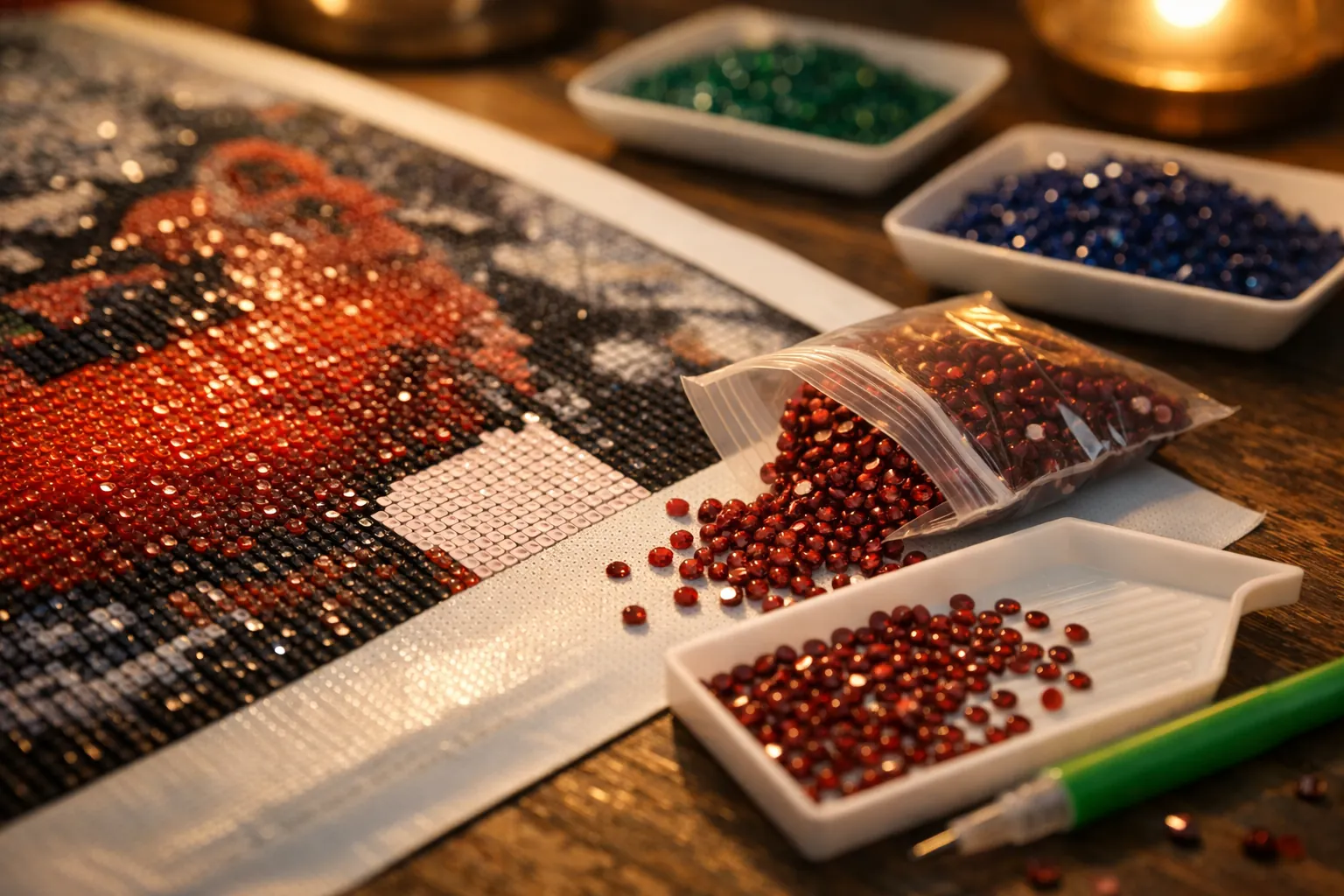
Message the seller first: order number, the DMC code from the canvas legend, how many drills you're short and a photo. While you wait, keep painting around the gap. If no replacements come, buy a single-color pack in the same DMC code, or a multi-color spare set if you paint a lot. Prevention is cheap too: check every bag the day the kit arrives, while you're still inside the seller's return window.
The four steps, in order
| Step | When | What to do | Tool |
|---|---|---|---|
| 1. Check | Day it arrives | Match every symbol on the legend to a bag. Note missing or tiny bags. | Project log arrival check |
| 2. Claim | As soon as you spot it | Message the seller with the code and count, plus a photo (template below). | Your order page |
| 3. Identify | Before buying anything | Read the DMC code from the legend; check your spare stash. | DMC color chart |
| 4. Replace | If the seller can't help | Buy that code, or substitute a close color for scattered cells. | Single-color pack |
Step 1: check the kit when it arrives
Most people discover a missing color halfway through, weeks after delivery. Checking takes ten minutes. Lay the bags out in code order, read down the legend printed on the canvas and tick each code as you find its bag. Note any code with no bag, and any bag that looks far too small for the area it has to cover.
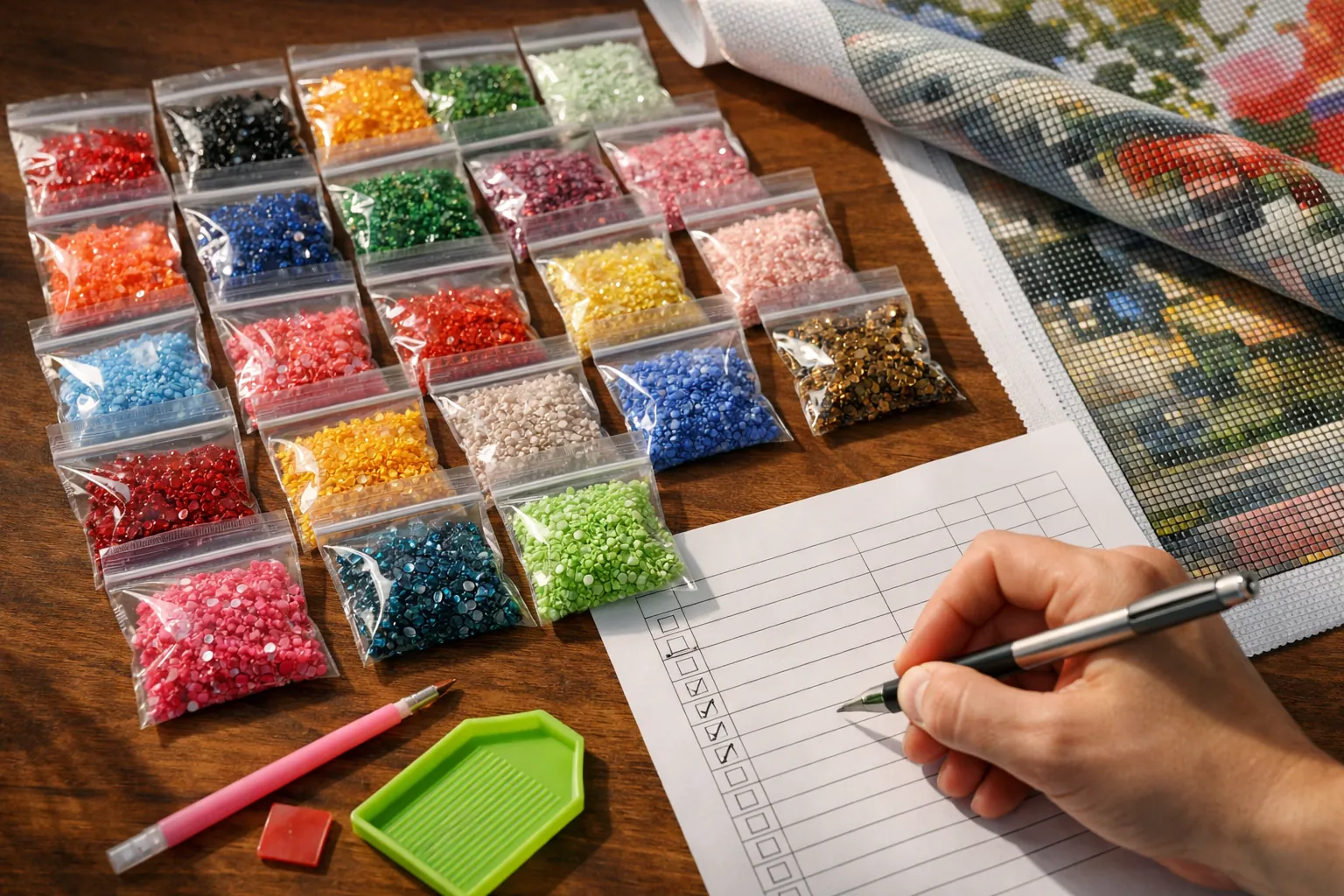
Our free diamond painting project log has an arrival-check box for this: missing codes, the date you contacted the seller and their reply. It's useful later if you need to show when you reported the problem.
A bag that runs out mid-project isn't always the seller's fault. Drills bounce off the table, stick to sleeves and end up in the vacuum. That's still worth a message, but say what happened.
Step 2: ask the seller, with a message that gets a reply
Sellers get vague complaints all day. A message with the exact code and count is quick to act on. Copy this and fill in the blanks:
Hello, I bought [kit name] on [date], order number [number]. The kit is missing drills in DMC [code] (symbol [symbol]). I'm short about [number] drills; that color has [number] symbols left uncovered on the canvas and the bag is empty. The drills are [round/square]. A photo of the legend and the empty area is attached. Could you send replacements? My shipping address is on the order. Thank you.
If you bought on Amazon, contact the seller from the order in Your Orders so the message is attached to the purchase. Keep your photo and the date in your project log.
Step 3: identify the DMC code
Almost every kit labels its drill colors with DMC numbers, the color codes DMC uses for its embroidery floss. The legend on the canvas pairs each symbol with a code, and the bags carry the same code. The single-color replacement packs below say the same thing in their listings: colors follow the "DMC447 standard color card", with the code printed on the bag.
Our DMC color chart for diamond painting lists the codes with names, plus a printable checklist for tracking your spare stash. Look there before you buy anything: you may already have that code in leftovers from another kit.

One caution: a DMC code is a color target, not a guarantee. Each drill maker mixes its own resin, so DMC 310 (black) from one brand can look a shade different from another's. In scattered cells you'll never notice. In one large block, you might.
How many replacement drills to order
Count the uncovered symbols for that code if the area is small. For a bigger area, estimate from its size. Standard drills pack at a fixed density, the same numbers our diamond painting calculator uses:
| Drill shape (size) | Drills per square inch | Drills per square cm | A 2 x 3 inch patch needs |
|---|---|---|---|
| Square (2.5 mm) | about 103 | 16 | about 620 |
| Round (2.8 mm) | about 82 | 12.8 | about 490 |
Density = (25.4 ÷ drill pitch in mm)². Some round-drill kits print on a 2.5 mm grid, so check your canvas.
Add a buffer for drills lost to the floor, 10 to 20 percent. The calculator's spare-drill setting does this for a whole canvas. In practice a single-color pack holds thousands of drills, so one pack covers almost any shortfall.
Step 4: buy replacements (or substitute)
Three ways to buy, depending on how often this happens to you:
- One code, one time: a single-color pack. This DMC 310 black pack has 5,000 round drills of about 2.8 mm in two bags, and the same seller lists other codes. Search the listing's color options for your code.
- A starter stash of common colors: the 30-color set has about 500 round 2.8 mm drills per color, 15,000 in all, with codes printed on the bags.
- Every code, for regular painters: the ARTDOT 445-color set has 200 round drills in each of 445 colors (89,000 total), individually bagged and numbered. It has 4,800+ ratings. Two hundred drills covers scattered gaps, not a big block.
All three are round drills. Square-drill painters need square packs, so check the shape in the listing before ordering.
No replacements at all? Substitute. Pick the nearest color from your spares (hold candidates against the canvas in daylight), use it in scattered cells or the edges of an area, and keep the true color for the middle. Nobody spots one off-shade drill in a busy area.
Never be short again: keep a spare stash
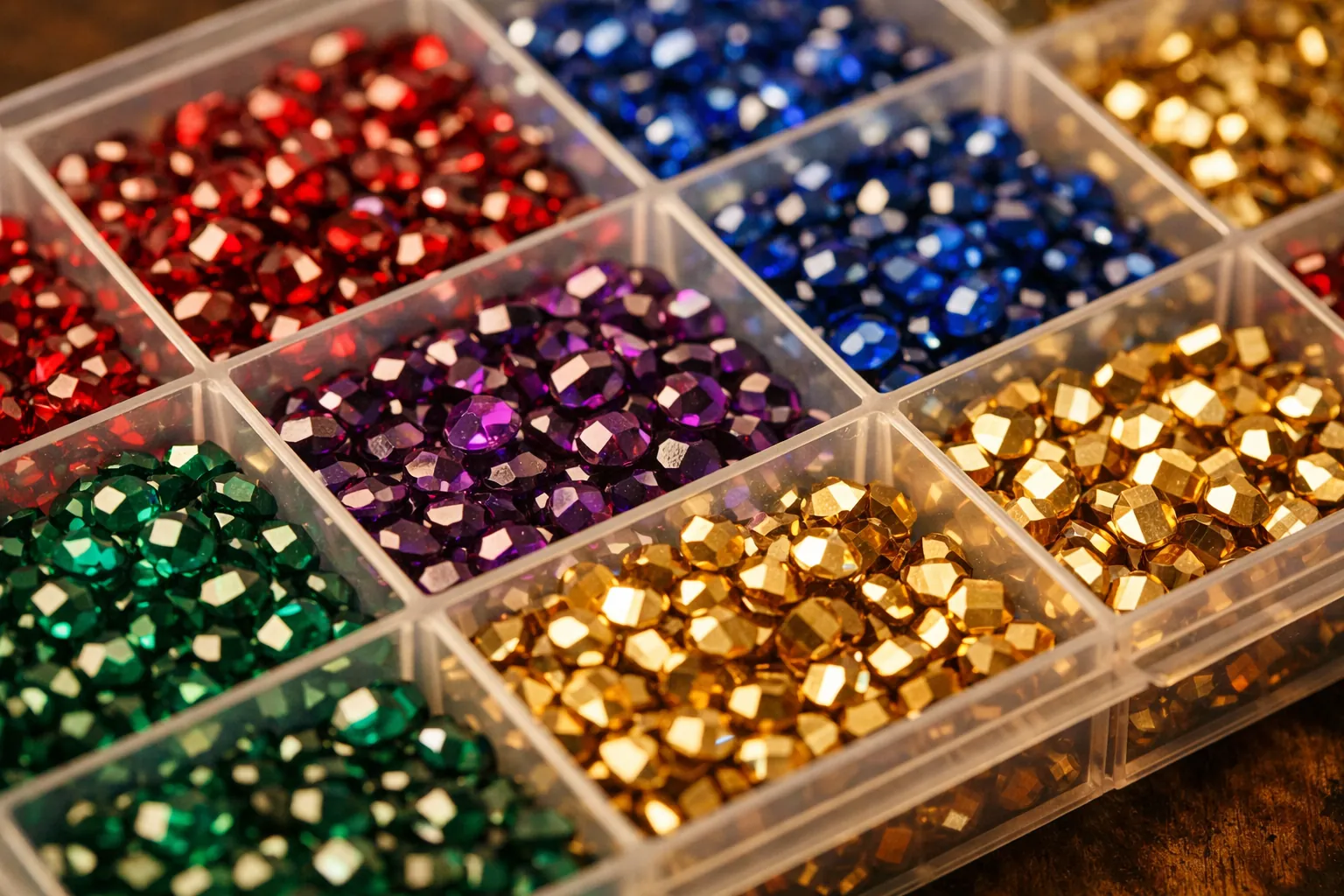
Every kit leaves extra drills. Pour each color into a labeled compartment when you finish, and the next missing-drill problem solves itself. The Mr. Pen 28-grid storage boxes (2-pack) come with 160 blank labels for codes. Track what you have on the DMC checklist, and see what to do with leftover drills for projects that use up the rest. Our storage guide compares bigger systems.
What to keep on hand
- A printed project log for the arrival check (free).
- Labeled storage for leftovers: Mr. Pen 28-grid boxes.
- For heavy users, a full-palette spare set: ARTDOT 445 colors.
Drills there but not holding? That's a glue problem: see drills not sticking. More first-kit help is in our tips for beginners.
Drill counts and sizes come from each seller's Amazon listing, checked October 3, 2026. Densities use 2.5 mm square and 2.8 mm round drill sizes. How we research · Affiliate disclosure