
5D diamond painting is ordinary diamond painting. The "5D" describes how each drill (the tiny resin gem you stick to the canvas) is cut: more facets on its face, so more sparkle than an older 3D drill. It isn't a measure of quality, and there's no industry standard behind it. Nearly every kit sold today says 5D on the box, so the label won't help you choose. Drill shape, coverage and canvas size will.
What the "D" counts
The D isn't dimensions in the usual sense. It describes the facets, the flat angled faces molded into the top of each drill. Faber-Castell, which sells Big Gem diamond painting kits for children, explains it this way on its blog: a 3D drill has three facets per side, nine in total, and a 5D drill has five per side, fifteen in total. More facets means more surfaces catching light, which is why a 5D canvas looks more like a mosaic of glitter than a mosaic of beads.
Rocky Nook's guide to drills says the same about facets per side and adds the sizes: standard drills are about 2.5 to 2.8 mm across, made of molded resin or plastic.
Why 5D isn't a standard
Nobody regulates the label. Faber-Castell's blog counts 15 facets on a 5D drill. The listing for a best-selling CHWGLFGG 5D landscape kit on Amazon says each of its round drills has 26. Both are sold as 5D. Some keychain sellers call their kits 6D. None of these numbers can be checked from a product photo, so treat them as marketing, not a spec.
The label is also close to universal now. In our Amazon search for "5d diamond painting kits" on October 13, 2026, 77 of the 106 kit titles said 5D, and none used 3D for drill facets. In a second search, for "diamond painting kits for adults", the only two titles that said 3D were wooden Christmas house kits, where 3D means a standing three-dimensional object. That's the other common use of "3D" in this hobby, alongside 3D ornaments and suncatchers.
What the listing says, and what it means
These are the labels that change how your finished painting looks and how long it takes. If two kits differ on any of these, that difference matters far more than 3D vs 5D.
| On the box or listing | What it means | Why it matters |
|---|---|---|
| 5D (or 3D, 6D) | Facet cut of the drill top, seller's own definition | Little. Almost every kit says 5D |
| Full drill | The whole picture gets drills | More drills, more hours, a fully covered finish |
| Partial drill | Only the subject gets drills; the background stays printed | Faster; a sparkle-on-print look |
| Round drills | Round gems that leave tiny gaps | Easier and quicker to place; softer, more glittery look |
| Square drills | Square gems that butt edge to edge | Crisper, more photo-like detail; slower and fussier |
| AB drills | Aurora borealis coating that flashes color | Extra shimmer on highlights like water or snow |
| Special shape | Shaped drills or crystals in parts of the design, usually partial | Raised, 3D-looking texture in those areas |
| Pearl | Round pearl beads used in parts of the design | A satin sheen instead of sparkle |
| Canvas size (cm) | Usually the canvas or design area, such as 30x40 cm | Bigger canvas means more detail and more hours |
Square or round is the decision people agonize over most, and our square vs round guide has the full comparison.
Full drill or partial drill
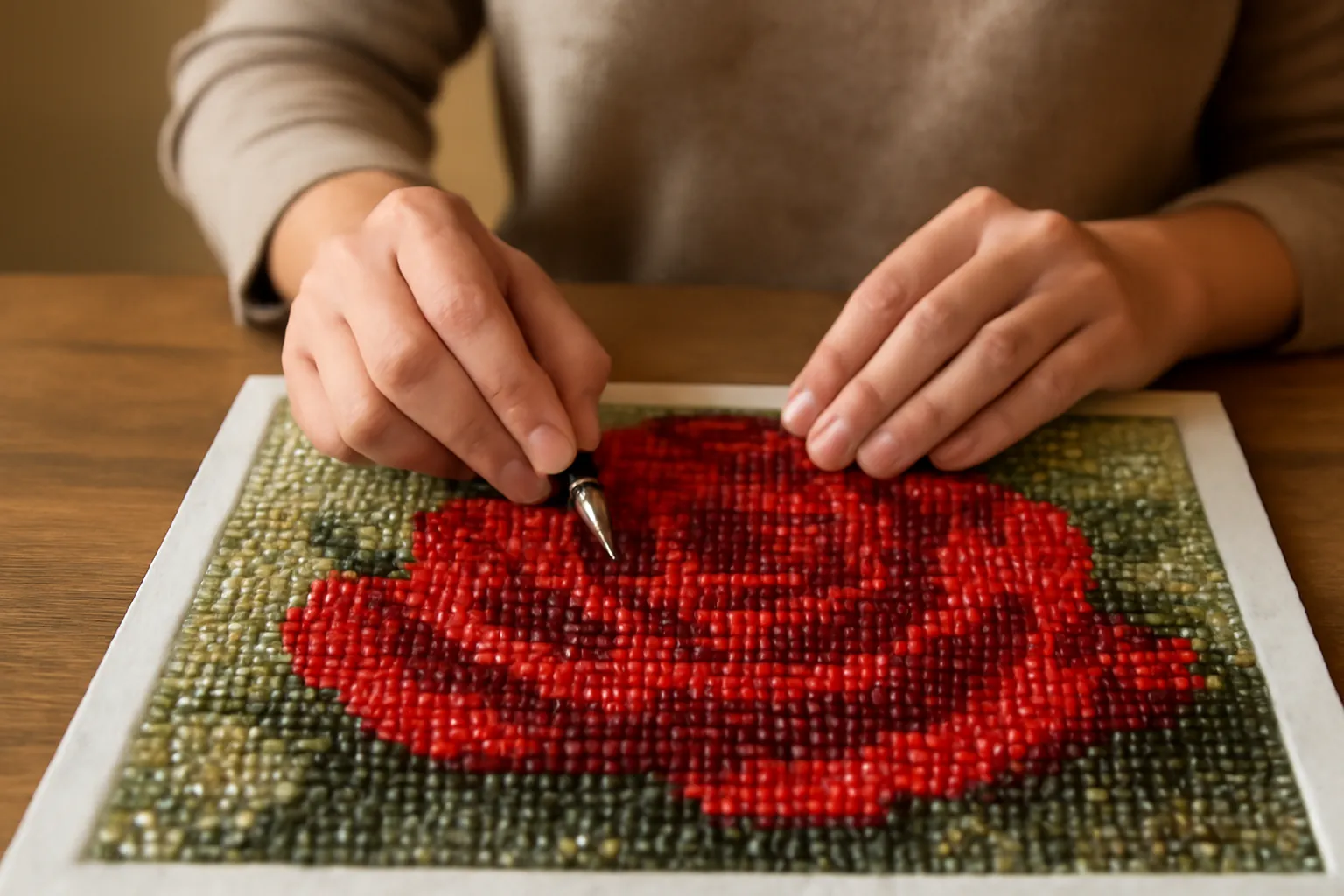
A full drill kit covers the entire canvas. The TOPMCYSG butterfly kit, for example, is a 12x16 inch round full drill canvas and the seller adds 30% extra drills. A partial drill kit, like the ZQEATRY sea turtle, mixes special-shaped drills with areas that stay as printed canvas. Partial kits finish faster and suit a first try or a small gift. Full drill is what most people picture when they think of diamond art, and once you're hooked, our large full drill kits guide picks the big ones.
How many drills is that? A worked example
Take a 30x40 cm design area, the most common kit size. Our diamond painting calculator assumes round drills sit on a 2.8 mm grid and square drills on a 2.5 mm grid.
- Round: 300 mm divided by 2.8 is about 107 drills across, and 400 mm divided by 2.8 is about 142 down. That's roughly 15,200 drills.
- Square: 120 across by 160 down is 19,200 drills.
So the same picture in square drills needs about a quarter more drills, and the extra density is where the crisper detail comes from. Real kits print a blank border, so actual counts run a bit lower. Neither number changes with the 5D label.
AB drills, pearls and special shapes
AB (aurora borealis) drills carry an iridescent coating that shifts color as you move. Kits use them for water, frost and anything else meant to shimmer, and you can buy them in bags to swap into a finished canvas. Pearl kits, like this GEMFAMILY pearl wave kit, use round pearl beads in parts of the design for a soft sheen. Special shape kits use drills of different sizes and shapes, some raised, which is the one place the finished painting does look three-dimensional.
If your kit codes its drills by number, those numbers follow the DMC thread color system; our DMC color chart lists them.
What to buy for a first kit
Ignore the D. Pick a round drill, full drill canvas around 30x40 cm in a design with a few large areas of color, and check that the seller includes spare drills. A sky, a field of flowers or a landscape is more forgiving than a portrait. The beginner kits guide has picks that meet all of that, and our beginner tips cover the first hour at the table.
Sources: Faber-Castell, "5D Diamond Painting vs. 3D Diamond Painting" (2020); Rocky Nook, "Diamond painting: the diamonds"; Amazon listings and search results checked October 13, 2026. How we research · Affiliate disclosure